How to Elope in Gretna Green: A Complete Guide for Couples Eloping from England
Gretna Green has been the default answer to "let's just elope" for over 250 years. This started all the way back in 1754 when the Marriage Act was making it near-impossible for young English couples to marry without parental consent.
Quickly however, they discovered Gretna Green, which sits just two miles over the Scottish border as the first place you could actually do something about it. Blacksmiths doubled as marriage officiants, couples turned up by carriage, (or foot) and the whole thing became embedded in how people think about eloping in this country. It's referenced in Austen, it's referenced in Bridgerton, and it still processes around 3,500 weddings a year. Maybe more if you want to include the theatrical elopements where people go down to just take photos of "eloping".
But the romantic history only gets you so far when you're actually trying to plan one. Most of what's out there online is written by the venues themselves or by editorial sites that give you the broad strokes without much practical detail. Great if you live in Scotland but a majority of us don't. If you're sitting in England right now, trying to figure out the legal requirements, what the day actually looks like, how to get there, and what it'll cost; it's harder to find straight answers than it should be.
This guide is built to fix that. Everything a couple in England needs to know about eloping at Gretna Green. It's all laid out in the order you'll actually need it. Legal process first, then venues, then travel, timeline, costs, and timing. All in one place; saving you the need to open a dozen tabs at 3am.
Can You Still Elope at Gretna Green? The Legal Requirements
Before starting, it's worth stating Eloping in Gretna Green like in the movies or old days aren't possible here. Both partners are needed to sign a M10 form so your other half needs to know its happening. You can hide it from witnesses and such but the two of you need to be aware it's occurring. You can't just turn up anymore. That era ended a long time ago. There's a legal process now and sure it's not complicated, but it does require a decent amount of planning; especially if you're coming from England and haven't dealt with Scottish marriage law before.
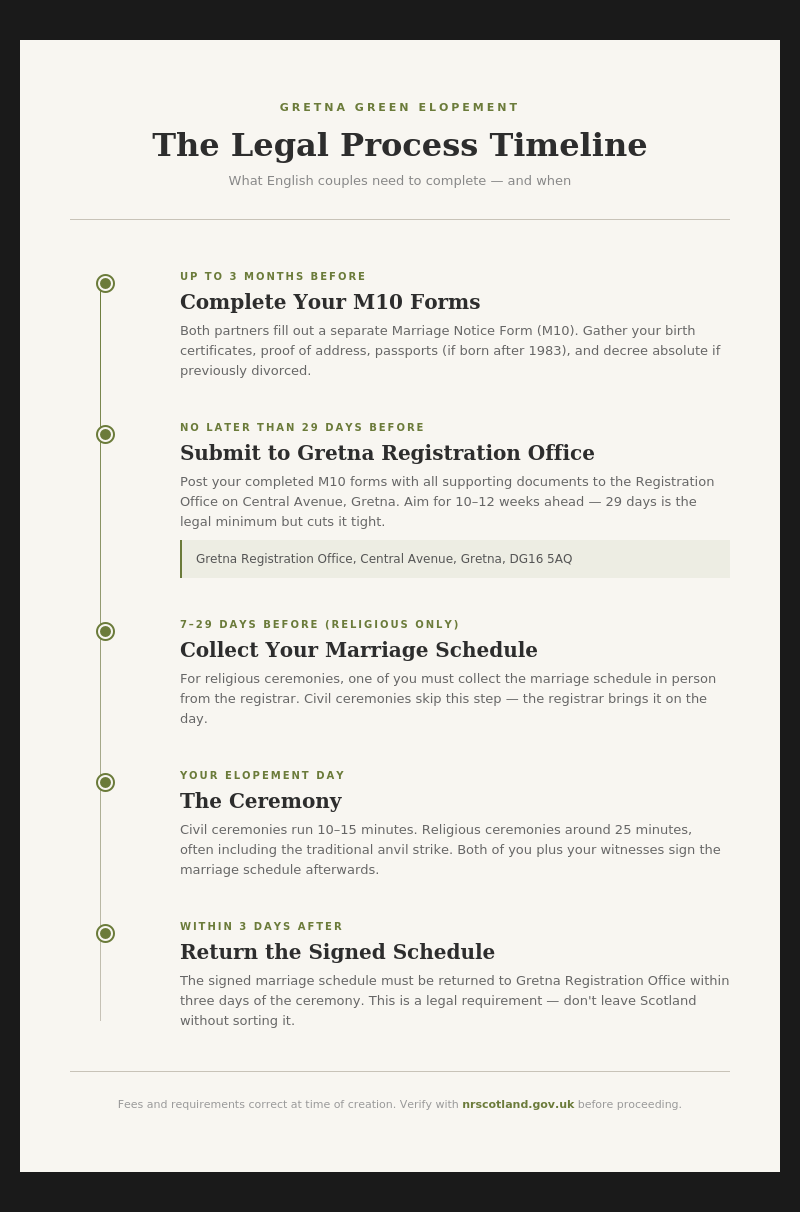
First off, what is an M10 form? - This form is the Marriage Notice Form for Scotland - both you and your partner will need to fill one out separately and it goes straight to the Gretna Registration Office along with: your birth certificates, proof of address (it can be a utility bill less than three months old, bank statements, etc), passports if you were born after 1983, and a decree absolute if either of you has been divorced. You'll also need to complete a separate celebrant and witness details form as yes, you need someone to witness your elopement, if you really want to be old school, your photographer can be one (if you have one) or nearby venues (like Mill Forge) can provide two for £40*.
Timing is the main issue here. The forms can't be submitted any earlier than three months before the ceremony but not before the absolute minimum of 29 clear days before. Yeah, it's really strange. The recommendation from the local registrar is to send yours in around 10 to 12 weeks, because if anything comes back incomplete or there's a query on the paperwork you'll be forced to postpone to fix said issues so give yourself the buffer. A quick note is that no residency requirement exists. You don't need to live in Scotland. You don't even need to set foot there until the day itself, provided your paperwork has no issues.
The main choice paradox for couples is either wanting a civil ceremony or a religious ceremony and this is important because it affects both cost and logistics. A civil ceremony is performed by a registrar and takes roughly 10 to 15 minutes. The registrar brings the marriage schedule with them on the day, so you don't need to collect anything in advance. The cost for this sits at around £400* for weekdays but is more closer to £600* for weekends and bank holidays, with the schedule fee included.
A religious ceremony however is one with a minister and runs about 25 minutes to 35. This tends to include more of the traditional Gretna Green elements like striking the anvil, and costs around £200* to £225* for the minister's fee. However! there's an extra £100* charge from the registration office for preparing the marriage schedule, and you or your partner will need to collect it in person; either on the morning of the wedding or up to a week beforehand; so this one is often avoided by couples eloping in Gretna Green if they're from England.
Humanist Ceremonies are authorised by the person performing the ceremony rather than the building where it happens. That means some ceremonies (such as those conducted by humanist celebrants) can take place outdoors or in unique locations if the spot is approved on the marriage paperwork.
After the ceremony, both of you and your witnesses sign the marriage schedule. That document then needs to go back to Gretna Registration Office within three days. Non-negotiable.
*=Fee's are sourced from cites online. Please check with your registrar and offices for the up-to-date pricing
Where to Say Your Vows: The Ceremony Venues
Gretna Green isn't an open-field venue. It's a cluster of ceremony spaces across a few different properties, each with a different feel and capacity. If you're eloping with just the two of you and a couple of witnesses, most of the larger rooms won't suit you. Here's what actually works for intimate elopements.
The Famous Blacksmiths Shop is the one most people think of when Gretna Green is brought up. The Original Marriage Room is the historic 18th-century space where Blacksmith Priests married runaway couples over the anvil. It holds up to 50 standing but works best when it's not full as it can feel a bit like a can of sardines. The atmosphere comes from the history of the room, not the size of it.
For something more contained, the Elopement Marriage Room sits within the Gretna Green museum. It's contemporary, smaller at around 20 standing, and feels purpose-built for intimate ceremonies without a larger room feeling half-empty.
Gretna Hall was built in 1710 as a manor house and has a few ceremony spaces. The standout for elopements is the Cottage. This is an open fireplace, candlelit, and fits about 5-10 guests. It also comes with a private garden which you can access directly from the room. This is great for photography because you're not walking through public areas to get outside. The Coach House is slightly larger with a historic carriage backdrop and the anvil, seating around 45 if you're bringing a small group. I'd say this is more couples who'd want that Little Women feel.
Smiths Hotel is the modern option, directly opposite the Blacksmiths Shop. The Penthouse is the elopement space; a private balcony, room for up to 6 guests, overlooking countryside. Less tradition, more contemporary luxury. A completely different feel from the historic venues. This is tailored to more couples who'd want that Bridgeton feel.
The Mill Forge Hotel sits about 2 miles from the village. Quieter, away from the tourist footfall, with its own ceremony space and accommodation. Worth considering if you'd rather not be in the middle of things.
Larger spaces do exist across these properties if you're bringing more people, but for a true elopement, the rooms above are the ones worth focusing on. Whichever you pick shapes how the day feels the atmosphere, the light, how the photos read. It's worth requesting a walkthrough before committing.
gretna Green & Travel Logistics
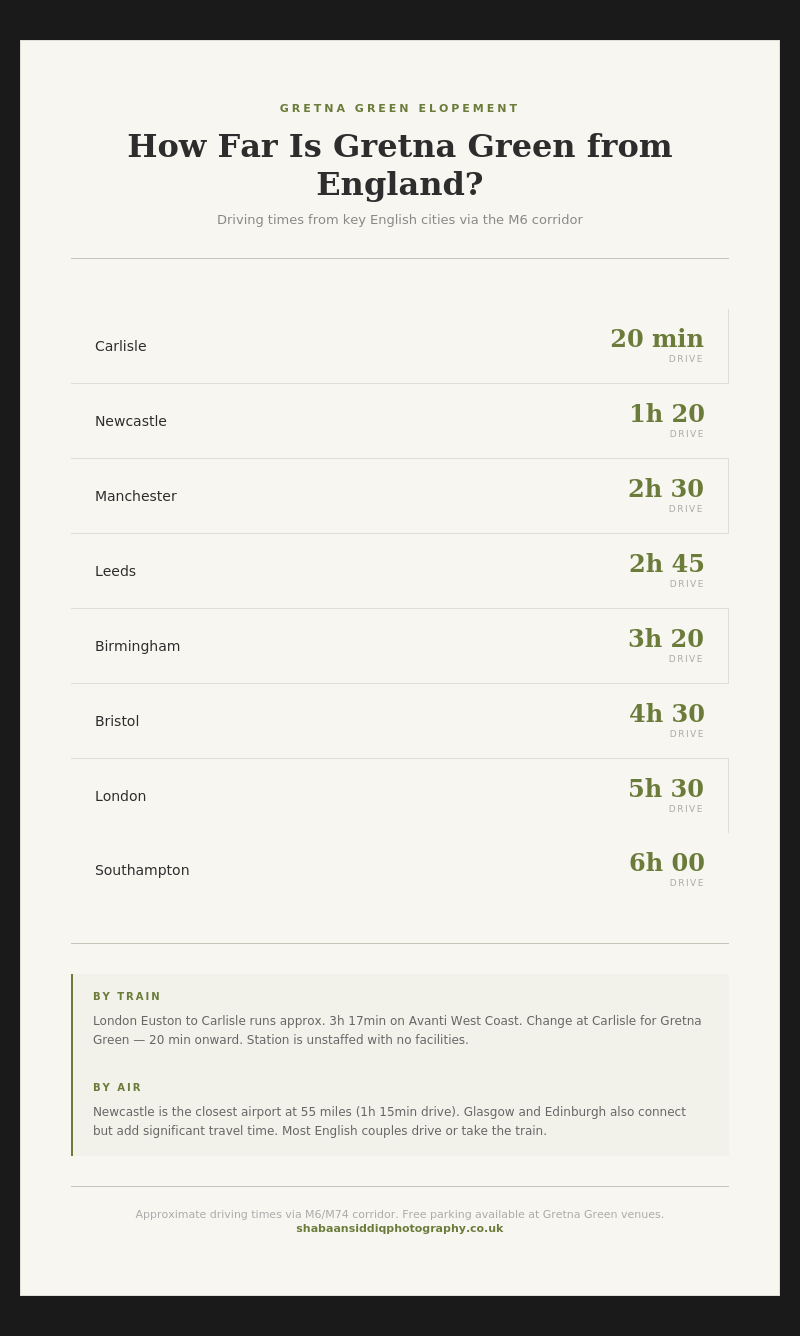
Gretna Green sits right on the Scottish border, just off the M74. If you're driving up from England you're going to be on the M6 for most of it. From Manchester, it's roughly two and a half hours. From Birmingham, around three and a half. From London, you're looking at five and a half hours. These all are extremely long journeys but some couples make a point of it. The road trip north becomes part of the story. Free parking is available on-site at the main venues, so you're not dealing with pay-and-display or hunting for spaces on arrival.
By train, Gretna Green has its own station. It's small, unstaffed, no ticket machines, no café; don't expect much beyond platforms and a shelter. Often fifteen trains operate on weekdays which is not a lot. The practical route for most English couples is to take a train to Carlisle on the West Coast Main Line and change there. London Euston to Carlisle runs about three hours on Avanti West Coast, and from Carlisle you're only twenty minutes out. Birmingham, Manchester, and Leeds all connect through Carlisle without too much hassle. Prices often vary so please book in advance for the most cheapest tickets possible.
If you're flying, Newcastle is the closest airport at about 55 miles, roughly an hour and fifteen by car. Glasgow and Edinburgh work too but add more travel time. For most couples coming from England, driving or taking the train makes more sense than flying unless you're combining it with a wider trip.
Accommodation is straightforward. The Smiths Hotel and Gretna Hall are both ceremony venues with rooms, so you can stay where you marry. There are also smaller Air B&Bs, and hotels in the area. Some couples stay in Carlisle the night before and drive up on the morning, which can feel less rushed than arriving and getting married on the same day. The Lake District is also only about an hour south, which opens up options if you want to turn the trip into a short break either side of the ceremony.
Planning Your Elopement Day: Timeline Tips
Elopement days fall apart when they're either over-planned or completely unstructured. You need enough of a framework to know where you're supposed to be and when, but not so much that it feels like you're running to a schedule on what should be one of the most relaxed days of your life. I wrote some tips below to help you understand how to plan for what, whether its a religious ceremony or a civil ceremony
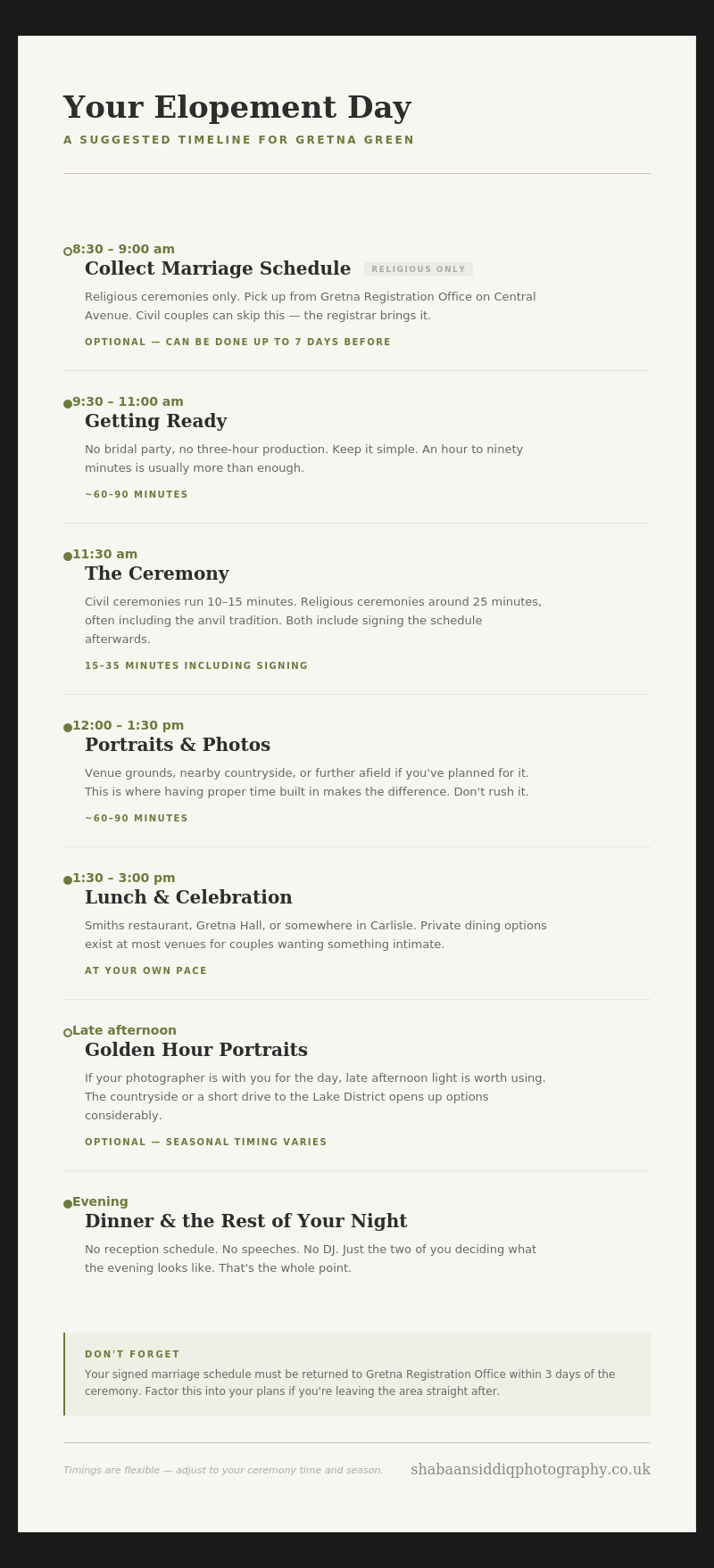
If you're having a religious ceremony, you'll need to collect the marriage schedule from Gretna Registration Office before the ceremony. The office is located on Central Avenue and you can pick it up either the morning of the wedding or up to a week beforehand. If you're staying the night before in Gretna Green doing it first thing in the morning takes that task off the table early or even arriving a day before and doing it then is still allowed. Civil ceremonies don't have this step, the registrar brings the schedule with them.
Getting ready doesn't need to take long. This isn't a wedding with a bridal party and a three-hour hair and makeup call. Most elopement couples keep it simple, which is part of the appeal. An hour, maybe ninety minutes, is usually enough.
The ceremony itself is short. A civil ceremony runs about 10 to 15 minutes, a religious one around 25 (maybe longer). Both include signing the schedule afterwards, which takes another 5 to 10 minutes with your witnesses. After that you're married. So far it's at latest taken 2 hours, maybe a bit more of your day.
After the ceremony is where the day opens up. This is your time for portraits, for breathing, for doing whatever you want. Most Gretna Green venues have grounds or nearby areas that work for photos. It's important to note if you've got a photographer with you that building in an hour or so to move around and shoot properly makes a significant difference to what you end up with. Rushed portraits after a ceremony never feel the same as ones where you've given yourselves space. Late afternoon light is usually worth waiting for if your ceremony timing allows it but don't worry if it doesn't as a good photographer can work in most lighting if not any.
From there, it's dinner, drinks, whatever you want the evening to look like. Some couples eat at Smiths or Gretna Hall. Some drive down to Carlisle or into the Lake District. There's no reception to manage, no speeches to sit through, no timeline dictated by a venue's turnaround schedule. That freedom is the whole point.
How Much Does It Cost to Elope in Gretna Green?
Costs often vary on what you want; the scale, location, hiring fees (like a wedding) but the baseline is lower than most people expect. You can elope at Gretna Green for well under a thousand pounds if you keep things simple! But when you make it more like a wedding and start to scale upwards with accommodation, a meal, photography, and a nicer venue room and you're now looking at a larger cost but still it is significantly less than a traditional wedding.
The legal costs are the fixed part. A civil ceremony performed by a registrar costs £400* on a weekday or £596* on weekends and bank holidays; that includes the marriage schedule fee. If you go with a religious ceremony instead, the minister's fee is around £200*, but there's an additional £100* to the registration office for preparing the marriage schedule separately. So the legal side sits somewhere between £300* and £600* depending on ceremony type and day of the week.
Venue hire is on top of that. The smaller, more intimate rooms which are the ones that actually suit elopements start from around £750* at Gretna Hall for the Cottage. Some packages bundle the ceremony and an overnight stay together from around £599*, which is often the most straightforward option if you don't want to piece everything together individually, however you might not want that room and/or bundle, but it's always best to consider things.
Where costs start to look more like a wedding and vary is in the extras. Accommodation, a meal, flowers, photography are all separate unless you've picked an all-inclusive package from a venue site. Midweek dates are almost always cheaper than weekends, and some venues run seasonal offers during quieter months like early spring or late autumn that can bring the total down noticeably.
For a rough estimate for an elopement with just the two of you, a ceremony in one of the historic rooms, one night's accommodation, and a meal afterwards you're realistically looking at somewhere between £800* and £1,500*. That range covers most of the needs without getting into luxury territory.
*All fees mentioned are correct at the time of writing. Check directly with the venues and the Gretna Registration Office for current rates before committing.
Best time of Year to elope in Gretna Green
There's no bad time, but different seasons give you a completely different day and a completely different set of photos.
Summer is the obvious choice and the most popular. There's more sun, warmer weather, more flexibility with your schedule and when the ceremony starts and when to take photos afterwards. Golden hour is much easier to work with and lasts longer, so if you want warm, glowy, naturally flattering photos you can do so without waiting for a specific time; summer makes it all the more straightforward. The trade-off is that Gretna Green is a tourist destination, not just a wedding venue. In peak summer you're sharing the village with visitors, coaches, and other couples. It's busier, louder, and harder to get moments that feel more intimate. Weekday dates help with that, but it doesn't disappear entirely. Hiring a private venue will take care of this but the tradeoff is the cost.
Autumn is underrated. The landscape shifts into browns and softer, richer tones and everything starts to look like it belongs on a Pinterest board without you trying. If you're drawn to that filmic, Little Women kind of aesthetic, that warm but muted palette with texture and depth, autumn delivers it naturally. Fans of Bridgeton might also want to wait for this too. September and October give you light that doesn't blow out at midday and stays usable for longer. It's also when venues start offering seasonal deals, so costs come down. Fewer tourists, more space, more of the village to yourself.
Winter is harsh. It's cold, the days are short, and rain is a regular feature. But if your taste is dark academia, gothic, candlelit-rooms-and-moody-skies kind of energy then winter is where that lives. The low light, the bare landscape, the atmosphere of a ceremony in a small room with candles and stone walls. It photographs well if that's the tone you're after, and it doesn't need to be forced because the conditions do most of the work. Midweek winter dates are the cheapest you'll find, and you'll likely have the venue almost entirely to yourselves and the surronding areas.
Spring sits somewhere between the extremes. March and April are unpredictable. You could genuinely get anything weather-wise from rain to golden sun but by May things settle and the landscape comes alive without the summer crowds arriving yet. It's a solid middle ground if you want decent conditions without peak pricing and footfall, though you're accepting more variability in what the day looks and feels like compared to committing fully to a summer or autumn date.
One thing that applies regardless of season: weekday ceremonies are almost always a better experience than weekends. Cheaper registrar fees, quieter venues, more flexibility with timing, and less pressure on the day running to someone else's schedule.
gretna green photography packages
Some venue packages include photography. It is worth knowing that upfront. The included option is typically a set number of posed shots taken during and immediately after the ceremony such as the signing, the kiss, the anvil, a few portraits outside. It covers the basics and it's convenient because it's already arranged.
Where it falls short is everything else. The getting ready. The drive up. The quiet moments between the formal ones. The hour after the ceremony when you're wandering around with no agenda and the day starts to feel real. Package photography generally doesn't extend to any of that, and it's rarely styled to a specific aesthetic. You get a record of the event. You don't necessarily get something that feels like yours.
If how your elopement looks and feels matters then hiring a specific vendor is worth it. If you've got a visual reference in your head, a tone you're drawn to, a Pinterest board that reflects something specific then bringing your own photographer gives you control over that. You choose someone whose existing work matches what you want, you build in proper time for portraits rather than rushing them in ten minutes outside the venue, and you end up with a set of images that reflect the full day rather than just the ceremony.
same sex elopements
Good news! Same-sex marriages have been legal in Scotland since 2014. The M10 form, the legal process, the venues, the costs, all identical regardless of whether you're a same-sex couple or not. You don't need to check, you don't need to ask permission, and if any vendor makes you feel like you do, that's a them problem and not a you problem; probably swap vendors if they do. Gretna Green processes thousands of weddings a year and that includes LGBTQ+ couples eloping the same way everyone else does. What's the point of running away if you can't feel free.
Planning a Gretna Green Elopement?
If you're considering eloping to Gretna Green and want it documented properly not just the ceremony, but the full day, the way it actually felt I'd be happy to have a conversation about it. I travel from England for elopements, so I understand the journey you're making because I'm making the same one.
Planning your elopement? Here's what's next.
Still confused on the M10 form? Read our in-depth M10 guide here
Thinking about Cornwall or the Lake District instead? We've got full guides for both: Cornwall elopement guide and Lake District elopement guide.
On the photography side? How much a Gretna Green photographer costs and What Elopement Photographers charge across the UK break down exactly what to budget.
Not sure about the ceremony type yet? Civil vs Religious ceremony cover everything you need to know before you book and help you choose which one's best for you.
Still stuck on your venue? Read our Gretna Green Venue Guide to help you understand what each venue offers and what is best suited for your needs.
Wondering what actually happens on the day? Our Registry Office guide walks you through exactly what to expect from arrival to signing.