The Lake District is probably one of the most beautiful landscape in England, ranging from the mountains, lakes, valleys, ancient woodland, to the villages that look like they haven’t changed in a hundred years. If you’re thinking about eloping somewhere that feels genuinely dramatic without leaving the country or costing the equivalent of a film, it’s easy to see why everyone chooses Lake District.
But hold on, before you run off and start picturing vows on a mountaintop with a lake behind you, there’s something you need to know. In England, you can’t actually legally get married outdoors. Bummer, I know. Not even on a fell, or by a lake, or in a field. The law requires that the legal ceremony takes place in a licensed venue or a register office. That hasn’t changed; regardless of what Instagram shows you of couples exchanging vows in a summer lily field.
That doesn’t mean you can’t fully elope at the Lake District and have your ceremony on a mountaintop. It just means you split it. The legal bit happens at a registry office or licensed venue fifteen minutes, done. Then you have a celebrant-led ceremony wherever you want. A fell, a lake shore, Rydal Cave, a quiet spot in ancient woodland. The celebrant ceremony isn’t legally binding but it’s the one that feels like your wedding. Most couples who elope in the Lake District do it this way. Plus, it gives you that movie aesthetic you always have wanted.
This guide covers how it all works. Legal process, locations, venues, what the day actually looks like, costs, and timing. If you’re sitting at home wondering whether the Lake District is the right place to elope, this is written for you. Trust me, there's a lot of you (myself included).
Can You Legally Elope In the Lake District?
Short Answer? Yes. but with a caveat. You can absolutely elope at the Lake District. You can have the intimate ceremony by a lake, on a fell, in a cave, wherever you want. But the legal ceremony must happen in a licensed venue or register office. So the boring part always occurs, even if you want to be rebellious and runaway like they used
The process works the same as anywhere else in England. You give notice at your local register office at least 29 days before the ceremony. Both of you have to attend in person with your passport or birth certificate, along with: proof of address, and a decree absolute if previously divorced (the most recent one). The notice fee is around £35 per person. After the notice period, you can marry at your chosen licensed venue within 12 months. So this means you can now start booking venues outside your area, aka, Lake District.
For the Lake District specifically, Kendal Register Office is the main registry office serving the area. If you’re doing the legal ceremony there, it’s a simple, short ceremony and takes roughly about fifteen to twenty minutes if you're not doing anything else from bridal entrance and all that faff. The registrar fee for attending a licensed venue elsewhere in Cumbria is around £600*, which is higher than some other area but is solely due to the fact its seen as a "destination" despite being a backdoor trip for those up-north. Book the registrar at the same time as your venue because slots fill up, especially in spring and summer.
The alternative and the more popular approach for couples who want an outdoor ceremony is to do the legal bit at the registry office or a licensed venue (perhaps at your hometown) and then have a celebrant-led ceremony at your chosen outdoor location in Lake District. The celebrant ceremony can be completely personalised. Your vows, your words, your setting. It’s not legally binding but it’s the ceremony that matters. Some couples do both on the same day, others do the legal bit quietly on a separate day and keep the outdoor ceremony as the main event.
Same-sex marriages are legal throughout England and the process is identical regardless of the couple. No different forms, no different process.
Best Locations for a Lake District Elopement
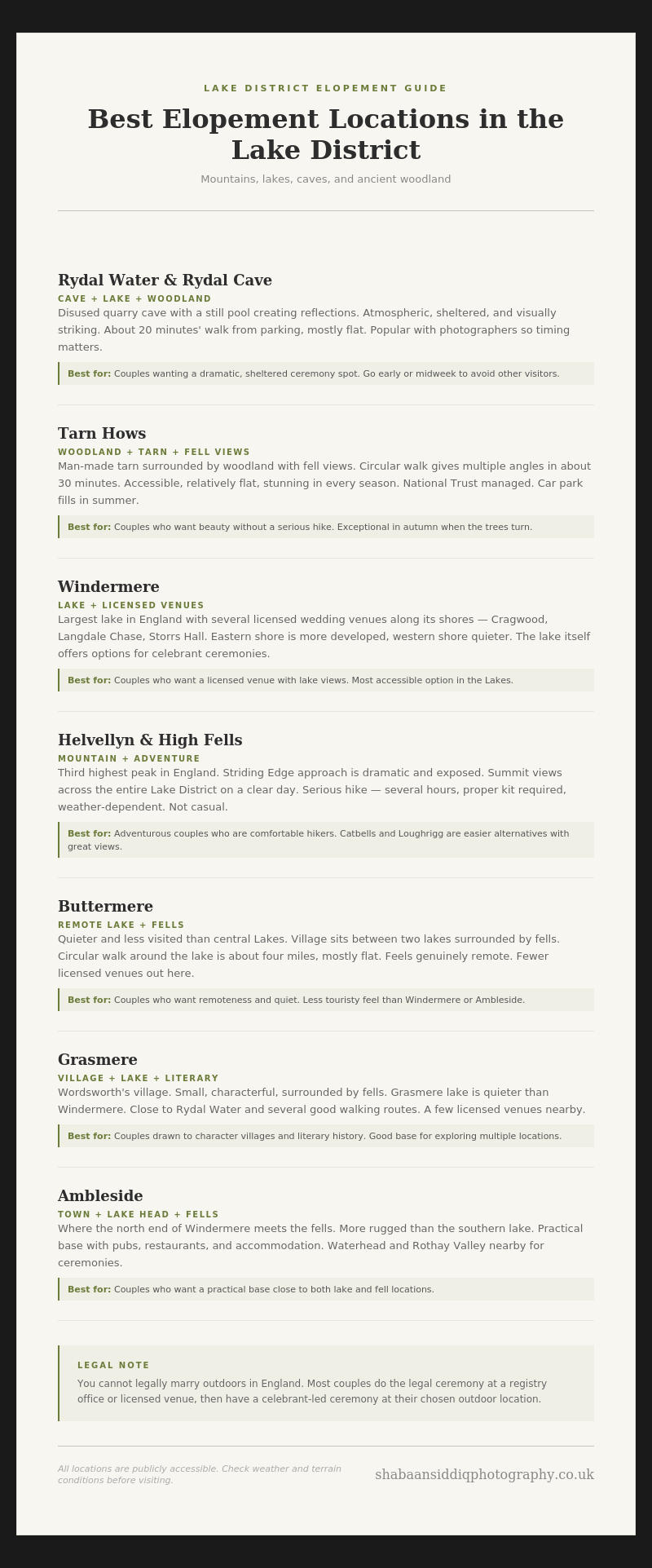
Windermere and Surrounding Area
This is the largest lake in England and the most accessible part of the Lake District; so its often the most popular and go to choice for couples. The eastern shore has several licensed wedding venues with lake views such as: Cragwood Country House, Langdale Chase, Storrs Hall to name a few.
The western shore is quieter and less developed. Windermere (the town) itself is busy and touristy, but the lake’s edges offer quieter spots. For celebrant ceremonies, the shoreline and woodland around the lake give you options without a major hike. In summer and spring you might often have a few vows scattered across the lake so try to not pay attention to others; as well as general footfall traffic being high.
Rydal Water and Rydal Cave
This is much smaller and much more quieter than Windermere, but that doesn't mean its unknown. This is one of the most popular elopement spots in the Lakes and its known as Rydal Cave. It’s a disused quarry cave with a pool of still water that creates reflections of the rock above. Atmospheric, sheltered, and visually striking. The walk in is about 20 minutes from the nearest parking, mostly flat. It’s not a secret as photographers and couples know about it, much more it's less crowded overall but will still have visitors so timing matters. Early morning or weekdays are best when people have yet to leave their bed.
Tarn Hows
A man-made tarn surrounded by woodland and fell views. It’s one of the most photographed spots in the Lake District for good reason! The circular walk around the tarn gives you multiple angles and backdrops in about 30 minutes. Accessibility wise it's relatively flat, and beautiful in every season. Autumn is exceptional here when the trees turn, and it's also conveniently managed by the National Trust so its always upkeeped so you don't need to worry about random junk and animal manure in the background of your romantic vows.
Helvellyn and the High Fells
If you want a mountain elopement, Helvellyn is the classic choice. The Striding Edge approach is dramatic and exposed and overall its genuinely adventurous. The summit gives you views across the entire Lake District on a clear day. This is not a casual walk though. It’s a serious hike that takes several hours, requires proper kit, and is weather-dependent. Couples who do this need to be comfortable hikers and accept that conditions might change their plans. Other fells like Catbells and Loughrigg are more accessible alternatives with still-impressive views. As someone whose done this hike, it is not easy as youtube videos make it seem. I would refer couples who are non-hikers to other locations. Also good luck getting your ceremonial person at the top.
Buttermere
This one is like the quieter cousin, it's far less visited than the central Lakes. The village sits between Buttermere lake and Crummock Water, surrounded by fells. The circular walk around the lake is about four miles and mostly flat. It feels more remote and less touristy than Windermere or Ambleside as it's not a landslide attraction. There are fewer licensed venues out here, so it’s more suited to the celebrant ceremony approach with the legal bit done elsewhere.
Grasmere
William Wordsworth’s village. It's small, surrounded by fells and close to both Rydal Water and several good walking routes. Grasmere lake is quieter than Windermere and the village has a character that feels distinctly Lake District without being overrun. There are a few licensed venues nearby and plenty of options for celebrant ceremonies in the surrounding landscape.
Ambleside and the Head of Windermere
This is where the north end of Windermere meets the fells. It's more rugged than the southern lake and has a characteristic, less pinterest and more rural village aesthetic. This is for those who'd want that old-timey elopement look than just a pinterest runaway look. Waterhead and the Rothay Valley nearby give you lake and river options. Ambleside itself is a proper town with pubs, restaurants, and accommodation, making it a practical base for an elopement day.
What Does a Lake District Elopement Day Actually Look Like?
A Lake District elopement isn't a wedding nor does it follow that format. There’s no reception hall, no seating chart, no catering. It’s your day, shaped around the landscape and the weather. Don't equal it to a wedding timeline otherwise you're better off doing exactly that; a wedding.
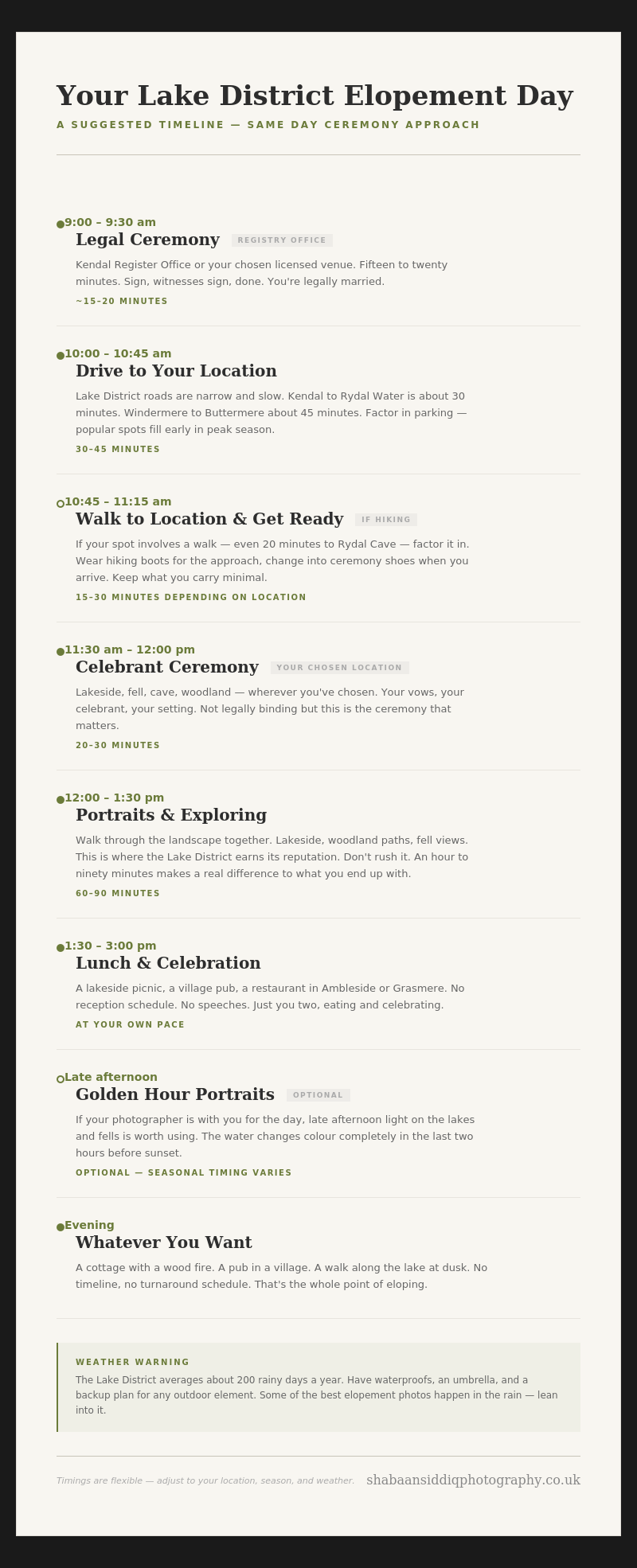
If you’re doing the legal ceremony and the celebrant ceremony on the same day, most couples start with the registry office. Kendal Register Office is the main option. It's a short ceremony, about fifteen minutes, with your witnesses (which are legally required; a minimum of two). Some couples often dress casually for this and change afterwards. Others wear their ceremony outfit for both. Either works. Come in whatever bridgeton aesthetic you thought looked cute or come in sneakers, it's your day.
From there, you drive to your chosen location. Lake District roads are narrow and can be slow (despite being 60 miles per hour), especially in summer. Windermere to Buttermere is about 45 minutes. Kendal to Rydal Water is about 30 minutes. Factor in parking and its around 45 minutes to an hour each depending on location; once again, during summer parking fills up quick so try to do your ceremony early in the morning.
If your location involves a hike; even a short one to Rydal Cave or a walk around Tarn Hows, you need to plan for that. Wear walking boots for the approach and change into ceremony shoes when you arrive. Carry everything you need in a rucksack. Try to park as close as possible, and also ensure you have any hiking gear (such as sticks) if you're new to hiking or traversing rocky cliffs.
The celebrant ceremony happens wherever you’ve chosen and it takes up to twenty to thirty minutes, personalised to you.
The Lake District earns its reputation in the hour after the ceremony where its just you two walking together through the landscape, the light on the water, the fells in the background. Build in at least an hour for this. Don’t rush it. Most people hire a photographer for up to three hours where they capture it all, start to finish (Ceremony to walking post vows).
Then it’s whatever you want. A pub lunch in a village. A picnic by the lake. A proper dinner at one of the local restaurants. Some couples book a cottage and disappear for the rest of the day. There’s no timeline dictated by anyone but you.
One thing to accept: it will probably rain at some point. The Lake District averages about 200 rainy days a year. That’s not a disaster — it’s part of the landscape. Rain in photos isn’t a problem if you lean into it rather than looking miserable. Have a waterproof layer, an umbrella, and a sense of humour. Some of the best elopement photos happen in the rain.
How Much Does It Cost to Elope in the Lake District?
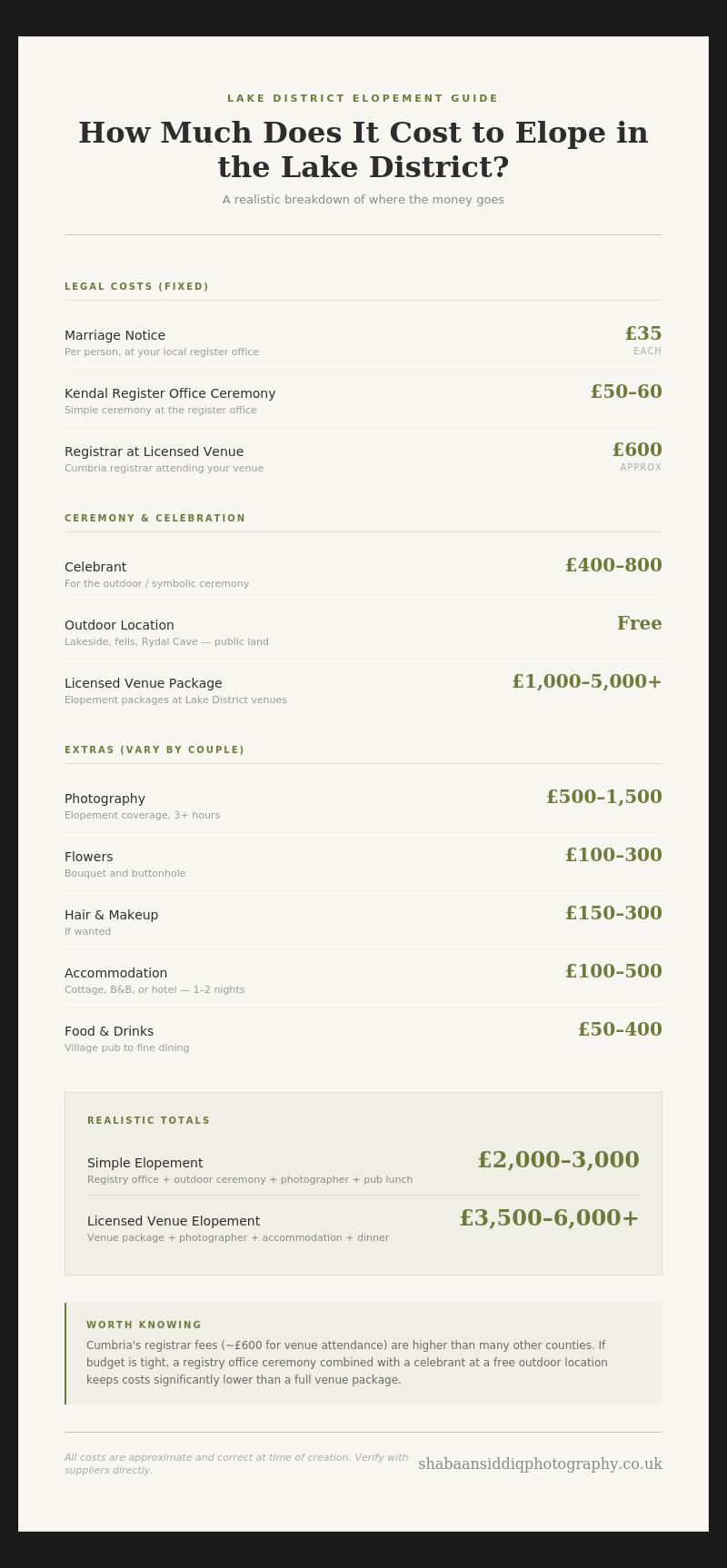
Lake District elopements range from modest to luxurious depending on how you structure the day. The legal costs are fixed. Everything else is flexible.
Marriage notice is around £35* per person at your local register office. So the clear cheap winner is do the boring stuff at home. If you want to do everything at Lake District, then the registrar fee in Cumbria is around £600* for attending a licensed venue, which is notably higher than some other counties. A simple ceremony at Kendal Register Office itself is cheaper. These fees are set by the local authority and change periodically, however last I checked it was £300*, please check with Cumbria County Council before budgeting properly.
A celebrant for the outdoor ceremony typically costs between £400* and £800*. This is separate from the legal registrar fee.
Licensed venue packages vary widely. The Lake District has some genuinely small wedding venues that are intimate. Elopement packages at places like Cote How, Gilpin Lake House, and Cragwood start from around £1,000* and go up to £5,000*+ for full-day exclusive use with accommodation, food, and styling included. Some venues only offer elopement packages midweek except in winter. So figure out how much of a "wedding" you want. If it's just the outdoor vows you want, you can stop at the celebrant cost and skip this entirely.
If you’re doing the legal bit at the registry office and having a celebrant ceremony at a public outdoor location, there’s no venue fee for the outdoor part. You’re paying for the celebrant, photography, and whatever you add on.
Photography, a florist, hair and makeup, accommodation, food all vary. To give a rough estimate for a Lake District elopement with just the two of you, a celebrant, a photographer, one night’s accommodation, and a meal: it ends up around being £2,000* and £4,000* (obviously dependent on the florist, photographer and makeup + accomodation but the cheapest I could make it was £2000). For a licensed venue package with everything included it went up a minimum of £3,500* and higher pricing went up to £6,000*+. The Lake District isn’t the cheapest place to elope in England, but it offers a lot for what you spend and if you avoid a venue you can save a lot.
*All fees are approximate and correct at time of writing. Verify directly with Cumbria County Council and individual venues.
Best Time of Year to Elope in the Lake District
Summer is the obvious answer. You get the longest days, the warmest weather, and the best chance of clear skies on the fells. Golden hour lasts longer than 30 minutes and the lakes are calm and not tidal. The trade-off is significant as the Lake District is one of the most visited national parks in England. Roads are jammed, car parks are full by 10am, and popular spots like Tarn Hows and Rydal Water have constant foot traffic. Weekdays help. Early mornings help more. But the crowds won't vanish just slowly appear. Also: midges. Tiny biting insects that swarm near water in warm weather. They’re a genuine nuisance and worth knowing about, so if you're wearing a dress and roll too close to water, I'd carry some anti-insectoid and plasters.
Autumn is arguably the best season for a Lake District elopement. The trees turn copper and gold and the light softens into something that photographs beautifully without trying. The tourists thin out noticeably after September as school picks up and so does work. Temperatures are mild enough to be outside comfortably but cool enough that the landscape isn't packed full of everyone else. If you want that filmic, rich, warm-but-moody aesthetic, autumn delivers it naturally. October is the sweet spot too.
Winter is raw, dramatic, and unpredictable. Short days, low cloud, rain, occasional snow on the fells. The landscape looks its most depressing. Frozen lakes, bare trees, mist sitting in the valleys. If you’re drawn to dark academia or gothic aesthetics, winter in the Lakes is where that lives. Licensed venues with fireplaces and candlelit rooms create a contrast with the wild outdoors that works powerfully in photos. Midweek winter dates are the cheapest and quietest option. The downside is that fell walks and exposed locations become genuinely difficult and potentially dangerous in winter conditions. Only do this in a barn/candlelit venue if you can, or perhaps before sunset for visibility and safety.
Spring is the wildcard. March is still warming up. April brings wildflowers and lambs but also unpredictable weather. May is when the Lake District starts to feel alive! Longer evenings, manageable temperatures. The crowds haven’t fully arrived yet. It’s a solid middle ground if you want decent conditions without peak season pricing and footfall.
Regardless of season: check the weather forecast obsessively in the days before. Have a backup plan for any outdoor issues and accept that the Lake District’s weather is part of its character. It rains here more than almost anywhere else in England, and that’s what makes it look the way it does and that's the tradeoff.
Practical Planning Tips
The Lake District’s terrain is demanding. Couples expect it to be easy, like walking uphill, but even a short walk to a lakeside spot involves uneven ground, potentially muddy paths, and inclines. Anything involving fells or caves requires proper hiking boots, waterproofs, and layers. Do not attempt a fell walk in wedding shoes. Bring them in a bag and change when you arrive at your ceremony spot, or if you can't do that, plan an alternative spot. It's always good to go to Lake District earlier to plan your locations out properly, or just Youtube.
A car is essential. Public transport exists but it’s limited and the best elopement locations are off the bus routes. The roads are narrow, winding, and slow. In summer, add extra time for traffic. In winter, check for road closures and ice. The nearest major airport is Manchester, about 90 minutes to two hours drive depending on where in the Lakes you’re headed.
Weather preparation is non-negotiable. Pack waterproofs, an umbrella, layers, and a change of clothes. Coastal weather is unpredictable but Lake District weather is on another level. You can have four seasons in a single afternoon. Your photographer and celebrant should be experienced enough to work with this, but you need to be mentally prepared for it too.
If you’re hiking to your ceremony location, keep your setup minimal. Flowers, rings, a flask of something celebratory. That’s it. Anything more becomes a logistical problem on uneven terrain. Also ensure your celebrant and photographer can hike. Often most people skip out on a photographer due to the steep incline and carrying such gear.
Book any overnight accommodation in advance, especially in summer and autumn. The Lake District has everything from luxury hotels to remote cottages, but the good ones fill up months ahead.
Lake District & Photography
The Lake District is a location where photography makes or breaks how you remember the day. The landscapes do a lot of the work, but a photographer who understands the terrain, the weather, and the light will give you a fundamentally different result from one who doesn’t. So just because they can shoot weddings does not mean they can shoot the highlands. One's calmer, the other you're stood nearer to the clouds than to the ground.
Lake District elopements often involve hiking, changing conditions, and locations that are difficult to reshoot if something doesn’t work. Your photographer needs to be comfortable on uneven ground, quick to adapt when the weather shifts, and able to find good light even when the sky isn’t cooperating. That’s a different skill set from shooting in a controlled venue environment.
The two-ceremony structure also matters for photography. The legal ceremony at the registry office is short and documentary. The celebrant ceremony and portraits afterwards are where the creative work happens. Building in proper time for portraits; walking through the landscape together, stopping at different spots, letting the day breathe all of this is what makes the difference between a handful of nice photos and a gallery that tells the story of your day. A recommendation is to have your photographer at the celebratory location earlier so you're not waiting for them to hike up, whilst you do the more mundane legal bit.
Planning a Lake District Elopement?
If you’re considering the Lake District for your elopement and want it documented properly — the fells, the lakes, the weather, the quiet moments that make the day feel real — I’d be happy to have a conversation about it.
Planning your Lake District elopement? Here's what's next.
Wondering what a photographer actually costs? Our full breakdown of elopement photography pricing across the UK covers what affects the price and what to expect at each budget. Read Here
Thinking about Scotland instead? Our complete guide to eloping in Gretna Green covers the legal process, venues, costs, and what the day actually looks like. Read Here
Prefer the coast to the fells? Our Cornwall elopement guide covers the best clifftop and beach locations, plus the two-ceremony structure. Read Here